Michael L. Riordan, M.D. — 1992 Gilead Sciences Annual Report Letter
Letter to Stockholders from the Founder, President & CEO of Gilead Sciences — with Product Development Overview and Science Illustrations
Cover
The report cover is dark and textured, with the embossed Gilead Sciences logo and the title “1992 Annual Report.”
Product Development Overview
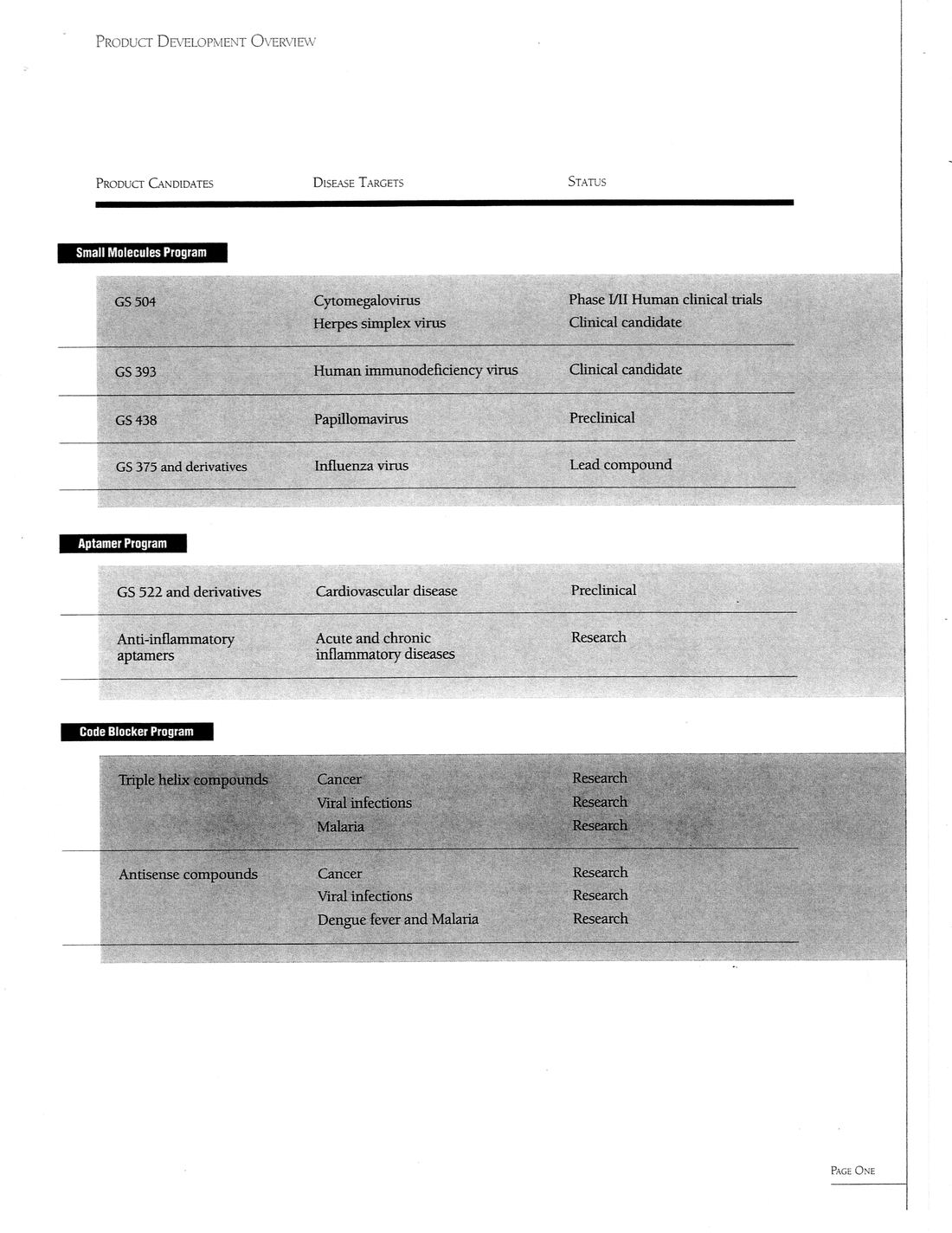
Page one of the report presents Gilead Sciences' complete 1992 product pipeline as a table of product candidates, disease targets, and development status, organized into three programs:
| Product candidates | Disease targets | Status |
|---|---|---|
| Small Molecules Program | ||
| GS 504 | Cytomegalovirus | Phase I/II human clinical trials |
| Herpes simplex virus | Clinical candidate | |
| GS 393 | Human immunodeficiency virus | Clinical candidate |
| GS 438 | Papillomavirus | Preclinical |
| GS 375 and derivatives | Influenza virus | Lead compound |
| Aptamer Program | ||
| GS 522 and derivatives | Cardiovascular disease | Preclinical |
| Anti-inflammatory aptamers | Acute and chronic inflammatory diseases | Research |
| Code Blocker Program | ||
| Triple helix compounds | Cancer | Research |
| Viral infections | Research | |
| Malaria | Research | |
| Antisense compounds | Cancer | Research |
| Viral infections | Research | |
| Dengue fever and Malaria | Research | |
Letter to Stockholders
To the Stockholders, Employees and Friends of Gilead Sciences:
Science is the driving force behind all that we do. Our goal is to harness our scientific expertise to develop therapies for severe diseases – viral infections, vascular disease and cancer. As a result of the extraordinary dedication of our scientific team, Gilead is on the forefront of transforming pharmaceutical discovery through nucleotide technology. Our disciplined approach to product development is driven by our emphasis on and belief in these values:
- Data – rigorous, incisive, productive research
- Teamwork – devoted individuals working toward common objectives
- Innovation – creative solutions to complex problems.
In fiscal 1992, we made substantial progress in our three product development programs – small molecules, aptamers and code blockers – all based on nucleotide technology. We continued to build an exceptional team committed to the demanding tasks of new drug development. We filed our first investigational new drug (IND) application, on GS 504, ahead of schedule in March, and we began human clinical trials in May. We also significantly strengthened our financial position by raising total net proceeds of $100 million through two offerings – $20 million in a private placement of stock in July 1991, and $80 million in an initial public offering in January 1992 – establishing a sound financial foundation for building a leading pharmaceutical company.
A New Class of Pharmaceuticals
Gilead is pioneering a new class of pharmaceutical compounds based on nucleotides – the molecular building blocks of DNA and RNA, the primary molecules of life.
Our scientists have shown that nucleotide-based compounds have the potential to treat many diseases more effectively than their traditional counterparts. Nucleotide compounds have several prospective sites of action and can be modified to act inside or outside the cell to selectively block the molecular causes of many illnesses.
Photograph caption (page three): Left to right: Michael F. Bigham, Executive Vice President and Chief Financial Officer, Michael L. Riordan, M.D., President and Chief Executive Officer, John C. Martin, Ph.D., Executive Vice President for Research and Development.
Our research and development efforts are focused on three interrelated and complementary nucleotide programs. Each of these programs draws from and contributes to the growing base of core nucleotide technology being developed at Gilead Sciences. In addition, our portfolio of research programs provides us with a range of commercial opportunities from nearer to longer term.
Small Molecules: Human Clinical Trials in Progress
Small molecules represent Gilead's nearest term commercial opportunity. These compounds are comprised of three or fewer nucleotides and may offer several therapeutic advantages such as high potency, infrequent dosing and oral administration.
Our first potential drug candidate is GS 504, our small molecule compound which is being tested for the treatment of cytomegalovirus infection. This disease afflicts AIDS patients as well as other immunocompromised individuals, such as transplant recipients. In March 1992 we filed an IND for GS 504, and in May we began human clinical testing in AIDS patients at an affiliate hospital of the University of California, San Francisco. If clinical results are positive, we will pursue additional indications for GS 504, including the treatment of herpes simplex virus, which is closely related to cytomegalovirus.
We plan to file an IND for GS 393, our second small molecule compound, by the end of 1992 to test its safety and initial efficacy in suppressing human immunodeficiency virus (HIV), the cause of AIDS. We are developing other small molecule compounds that we believe may play an important therapeutic role in a broad array of viral infections.
Aptamers: Powerful Drug Discovery Technique
We believe Gilead's aptamer technology represents a quantum advance in drug discovery. The word aptamer is derived from the Latin aptus, which means “to fit”. We use the term aptamers to describe chains of nucleotides that bind to and inhibit disease-causing proteins outside the cell. Our powerful drug discovery methodology enables us to rapidly identify promising aptamer compounds from a universe of more than a trillion molecules.
Gilead's first lead aptamer compound is GS 522, which in our preclinical studies has shown promise in preventing dangerous blockage of arteries and veins by binding to a protein that mediates blood clotting. If our animal studies continue to yield positive results, we plan to file an IND and initiate human clinical trials by mid-1994.
Code Blockers: Significant Long-Term Potential
Gilead's code blocker program involves blocking the genetic code of a disease-causing protein by selectively interfering with DNA or RNA function. We are pursuing two approaches: triple helix code blockers that bind to DNA within the cell's nucleus to selectively prevent gene expression, and antisense code blockers that bind to RNA to prevent the translation of disease-causing RNA into a protein.
As part of our code blocker program, we have formed a strategic alliance with Glaxo, one of the world's leading research-based pharmaceutical companies. This partnership reflects a significant research commitment on the part of both Glaxo and Gilead to the accelerated development of code blocker technology. Under the agreement, Gilead receives research funding from Glaxo and both parties benefit from the more rapid advances that are possible through the collaborative efforts of our two organizations. Gilead also receives research funding from the Defense Advanced Research Projects Agency (DARPA) to develop treatments for dengue fever and malaria.
Breaking New Ground with Nucleotide Technology
Gilead continues to build momentum. In fiscal 1993, we plan to complete Phase I/II human clinical trials for GS 504, to file an IND for GS 393 and to complete preclinical efficacy studies on GS 522. In our code blocker program, we expect to further develop our core technology and expand our patent foundation. To achieve these objectives, we will substantially increase our R & D expenditures as well as our scientific and clinical staffing. As we implement this expansion, we will adhere to our philosophy of disciplined growth.
Our goal for Gilead is to become a major pharmaceutical company by realizing the full potential of our pioneering science. As we continue to break new ground, there will be many challenges ahead; and while there can be no guarantees of success, we are committed to reaching our goal by building on these elements of the Company's strong foundation:
- Novel nucleotide-based therapeutics designed to combat severe diseases
- Dedication to the highest scientific standards
- An outstanding and versatile scientific and administrative team
- A strong, broad proprietary position in nucleotide technology
- A solid balance sheet to support our growth, with over $100 million in cash and short-term investments.
We believe that the pharmaceutical industry will be transformed through technological innovation in the years ahead. Gilead plans to be on the forefront of that process. Your support plays a critical role in making our goal a reality.
[Signature]
Michael L. Riordan, M.D.
President and Chief Executive Officer
June 1, 1992
The Power of Nucleotide-Based Drugs
Gilead Sciences is pioneering a new class of pharmaceutical compounds based on nucleotides, the molecular building blocks of DNA and RNA. Nucleotide compounds can be modified to act inside or outside the cell to selectively inhibit the production or activity of disease-causing proteins. The Company believes its therapeutics, if successfully developed, will offer significantly greater specificity, potency and efficacy than traditional drugs.
Product development at Gilead encompasses three interrelated and complementary nucleotide programs. Each draws upon and contributes to a common foundation of expertise in nucleotide chemistry and biology. Our goal in each program is to identify promising nucleotide compounds, chemically modify them to optimize their pharmaceutical properties, test them for biological activity and develop the lead compounds into drugs for particular target diseases.
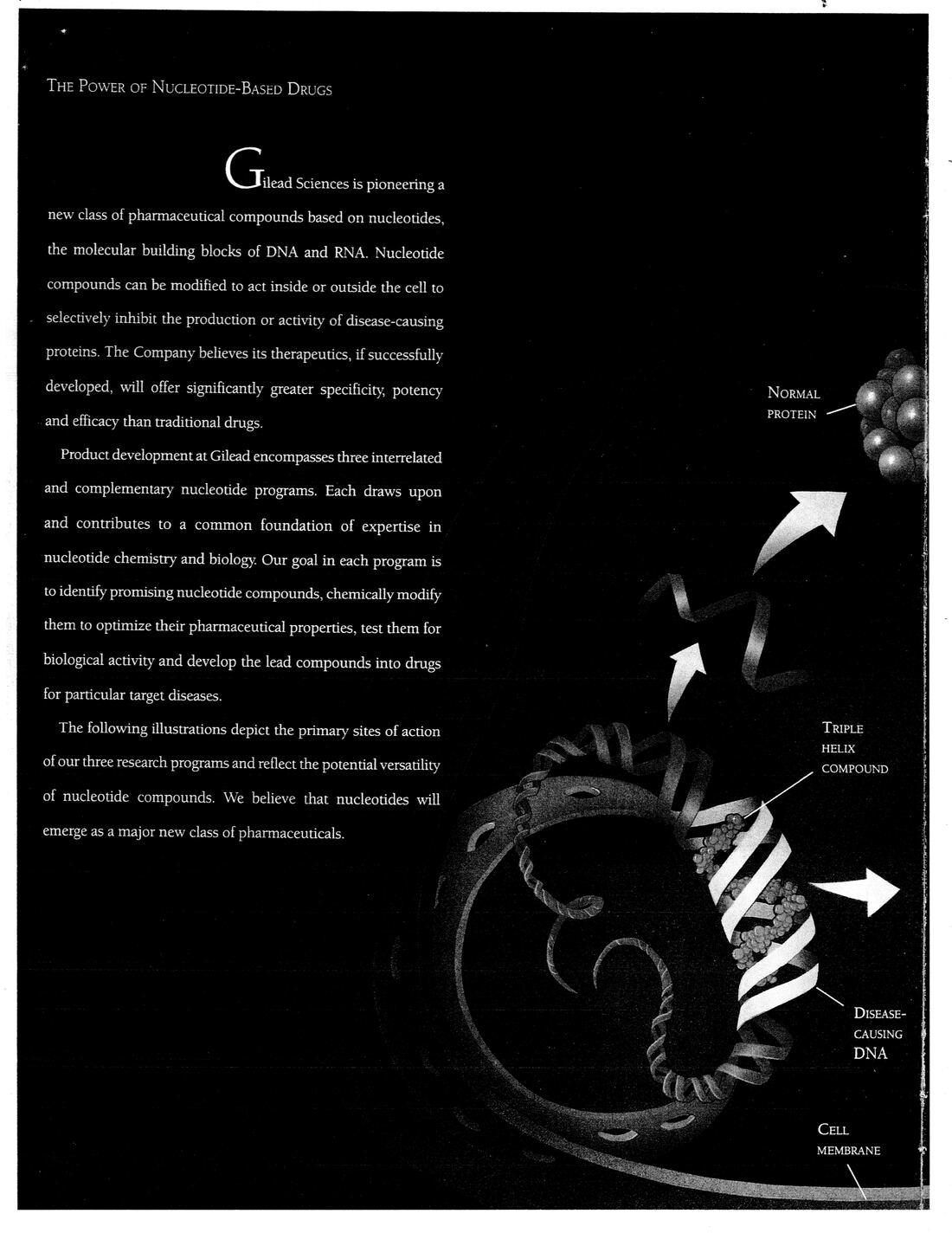
The following illustrations depict the primary sites of action of our three research programs and reflect the potential versatility of nucleotide compounds. We believe that nucleotides will emerge as a major new class of pharmaceuticals.
Illustration labels on this page: Normal protein · Triple helix compound · Disease-causing DNA · Cell membrane. The illustration shows a triple helix compound binding to disease-causing DNA inside the cell while normal protein production continues.
Small Molecules
Gilead's small molecule compounds are comprised of three or fewer nucleotides. These compounds are able to enter a virally-infected cell and inhibit viral replication.
Small molecule compounds offer other important pharmacological advantages. In preclinical studies, these compounds have demonstrated high potency, as well as high specificity to their intended target. In addition, these compounds have shown long duration of effect, measured in days. These properties should permit convenient, less frequent dosing than currently available anti-viral drugs. The low molecular weight of small molecule compounds makes them promising candidates for oral administration. Because of their distinct mechanism of action, we believe these compounds might provide prophylactic protection in uninfected cells.
Gilead's first potential drug candidate is GS 504, which is now in human clinical trials for the treatment of cytomegalovirus infection. This infection afflicts AIDS patients and other immunocompromised individuals, such as transplant recipients. Gilead also intends to pursue the use of GS 504 for the treatment of herpes simplex virus, which is closely related to cytomegalovirus.
Sidebar – Disease Targets: Cytomegalovirus · Herpes simplex virus · Human immunodeficiency virus · Papillomavirus · Influenza virus
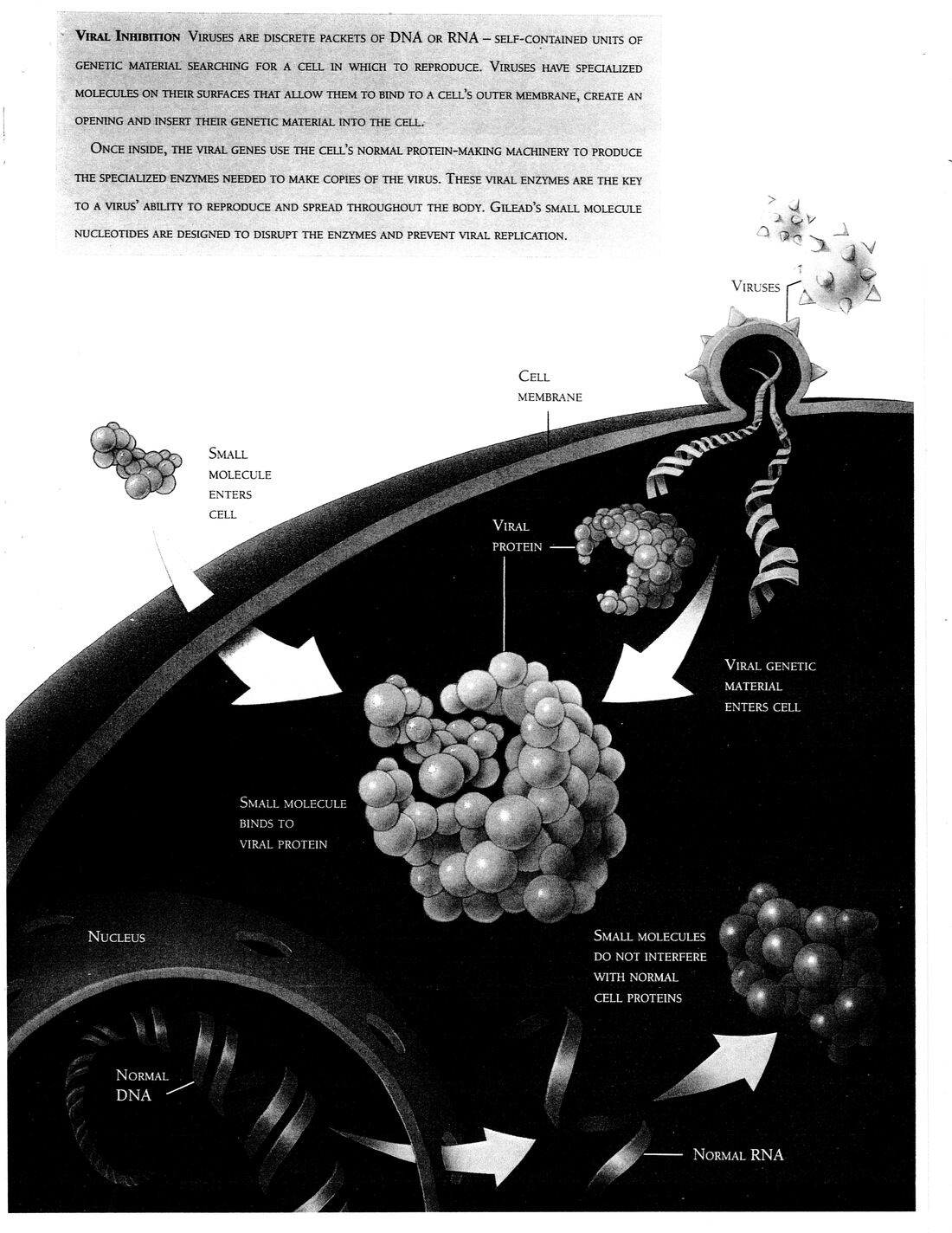
Disabling the Virus — A virus makes copies of its genetic material in a host cell by using nucleotides in the cell as the building blocks for new copies of viral RNA and DNA. Gilead's small molecule nucleotides are designed to act as decoys in the process – deceiving the viral enzymes that govern the replication process. As a result, the virus is unable to reproduce its genetic material.
Viral Inhibition (Full-Page Illustration)
Viral Inhibition — Viruses are discrete packets of DNA or RNA – self-contained units of genetic material searching for a cell in which to reproduce. Viruses have specialized molecules on their surfaces that allow them to bind to a cell's outer membrane, create an opening and insert their genetic material into the cell.
Once inside, the viral genes use the cell's normal protein-making machinery to produce the specialized enzymes needed to make copies of the virus. These viral enzymes are the key to a virus' ability to reproduce and spread throughout the body. Gilead's small molecule nucleotides are designed to disrupt the enzymes and prevent viral replication.
Illustration labels:
- Viruses
- Cell membrane
- Small molecule enters cell
- Viral protein
- Viral genetic material enters cell
- Small molecule binds to viral protein
- Nucleus
- Normal DNA
- Normal RNA
- Small molecules do not interfere with normal cell proteins
About this digitization
This page reproduces, as machine-readable text, the shareholder letter and science sections of the Gilead Sciences 1992 Annual Report, transcribed by OCR from a scan of an original printed copy. The scanned page images appear alongside the transcription so the original layout, typography, photograph, and illustrations can be viewed. Transcription follows the original text; obvious scanner artifacts have been removed.
Historical context (editorial note, not part of the original document): Gilead Sciences was founded in 1987 by Michael L. Riordan, M.D., and completed its initial public offering in January 1992. This document is presented for historical, educational, and archival reference.